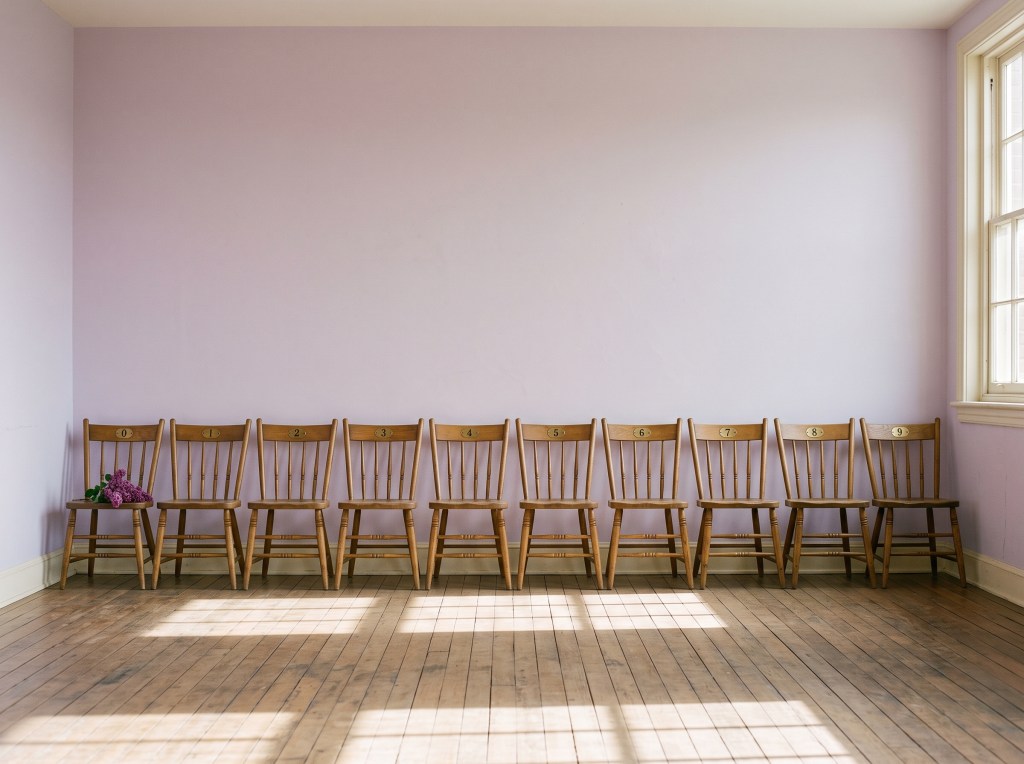
Last time I posted, I asked you to look up your number (here). I’m posting this on day 2,461,315. Yours is smaller, unless you’re reading this from the future, in which case: hello, and I hope it’s going well.
Here’s the thing about those numbers. However long they get, they’re spelled with the same ten characters, 0 through 9, reused forever. Every birthday, every bank balance, every date on every headstone is built from the same ten parts.
Before we read your number, I wanted to know what each of those ten has been saying all this time. So I called them as witnesses.
House Rules
Every number gets cross-examined by every discipline that ever had an opinion about it: mathematics, language, scripture, physics, biology, the calendar.
Some of these witnesses can be checked, like math and physics. Some speak from faith, like scripture. Some, like language, are mostly accidents of sound. I’m taking testimony from all of them, and I’ll tell you which is which.
When witnesses who’ve never met describe the same face, you don’t have proof. You do have a sketch. So each number ends with a verdict: not the one thing that’s true, but the one thing nobody could stop saying.
0. The Empty Chair
Zero is the only witness who showed up to testify that nobody was there.
- Mathematics: Add it to anything and nothing changes. Multiply anything by it and everything disappears. Divide by it and math declines to comment. Brahmagupta wrote down rules for zero as a real number in 628 CE; the Maya had already built their own for the Long Count calendar, without asking anyone.
- Language: “Zero” and “cipher” are the same word, from Arabic ṣifr, “empty.” Before that, it was Sanskrit śūnya, “void.” Fibonacci carried it into Europe in 1202 as zephirum.
- Religion: Buddhism’s śūnyatā, emptiness, isn’t absence. It’s the room things happen in. Genesis opens on an earth “without form, and void”: a zero, waiting for a first.
- Science: Absolute zero, −273.15 °C, can be approached but never reached. Even there, quantum mechanics says matter keeps a little restless energy, called zero-point energy. Nothing is never quite nothing. Physics even has a zeroth law, found after the first three and more basic than all of them.
- Calendar: There is no year zero; 1 BC is followed directly by AD 1. Astronomers got tired of that and put one back. The Julian count starts at day 0, which fell on a Monday in 4713 BC. Hence: Monday Zero.
Verdict: Zero is the place before anything. Not nothing, but the space nothing waits in.
Before you were anyone, you were an empty chair. The count had already set your place.
1. The Self
One insisted on testifying first. Nobody was surprised.
- Mathematics: Multiply anything by 1, and it stays the same. One isn’t prime; mathematicians voted it out to keep factoring tidy. It’s the unit everything else is counted in.
- Language: English hides one everywhere. “Alone” is all one. “Only” is one-ly. “Atone” means “at one,” which is what an apology is trying to make you again. “Universe” is Latin for turned into one.
- Religion: Judaism’s central prayer, the Shema, declares God is one. Islam’s tawhid is the oneness of God. The Sikh scripture opens with the numeral 1 itself: Ik Onkar, one creator. Plotinus called the source of everything simply the One.
- Science: Hydrogen is element 1, one proton and one electron, and roughly three-quarters of the ordinary matter in the universe. In real-world data, from river lengths to tax returns, about 30% of numbers start with a 1 (Benford’s law). The universe starts many things with one.
Verdict: One is the self. The first thing that can say I.
Notice how many of one’s words are lonely: alone, only. Then notice atone. One’s whole vocabulary is about being by yourself, and trying to get back.
2. The Other
Two arrived holding hands, or possibly arguing. The witnesses disagree, which is very two of them.
- Mathematics: Two is the only even prime. It’s the base of binary, so every screen you’ve ever loved someone through runs on it. The problem of two bodies orbiting each other can be solved exactly. Add a third and you can’t; more on that in a minute.
- Language: Twin, twain, between (by two), twilight (the light between). “Doubt” comes from Latin dubitare, built on duo: to be of two minds. “Dilemma” is two premises and no good exit.
- Religion: Yin and yang. Zoroastrianism’s light against dark. The ark loaded them two by two; Moses came down with two tablets. Everything in Genesis is called good until chapter 2: “It is not good that the man should be alone.” The first thing God objects to is loneliness.
- Science: DNA is two strands, each one the other’s mirror. A cell copies itself by pulling them apart and letting each find a new partner. You’re built in twos as well: eyes, hands, lungs, kidneys.
Verdict: Two is the other—the first number that can be in a relationship, and the first that can doubt.
Love needs at least two. So does doubt. They arrived together, and they’ve never fully separated.
3. The Story
Three is where things start happening on their own.
- Mathematics: The triangle is the only polygon that retains its shape when its corners are hinged; every bridge truss relies on it. Three points not in a line define a plane. And three bodies in orbit, unlike two, have no general solution. Three is where predictability ends.
- Language: Grammar has three persons: I, you, and someone else. Adjectives have three degrees: good, better, best. Comedy runs on three: setup, setup, punchline. The Latin tag omne trium perfectum says everything in threes is perfect.
- Religion: The Christian Trinity. The Hindu Trimurti: Brahma creates, Vishnu keeps, Shiva ends—Buddhism’s Three Jewels. Jonah spends three days in the fish, Christ three days in the tomb. The Magi are always three, though Matthew never counts them. He counts the gifts.
- Science: You see in color because your eyes have three kinds of cones. Every proton is three quarks. Space has three dimensions.
- Time: Past, present, future. Aristotle’s rule for a story: beginning, middle, end.
Verdict: Three is what two makes. The first number that’s a story instead of a situation.
Three is a family, a plot, a punchline. It’s the first time something exists that neither of the first two could have made alone.
4. The Walls
Four testified standing very still.
- Mathematics: Four is the first number made only of smaller ones: 2 × 2, a square. Four colors are enough to fill any map without neighbors matching. Proving that in 1976 took a computer, the first major proof that needed one.
- Language: In Chinese, Japanese, and Korean, the word for four sounds like the word for death, and plenty of buildings skip the 4th floor. Elsewhere we get quarters, squares, the four corners of the earth.
- Religion: Four Gospels. Buddhism’s Four Noble Truths. Four horsemen. The Hebrew name of God, YHWH, is a four-letter name, the Tetragrammaton. Tradition after tradition marks the four directions.
- Science: Four fundamental forces. Four letters in DNA: A, T, G, C. Four chambers in your heart. Four dimensions of spacetime.
- Calendar: Four seasons, four quarters, four phases of the moon, and a leap year every four.
Verdict: Four is the walls—the number of things built to hold still.
Some languages noticed that the stillest thing of all is death. I’d only add that four is also the number of rooms in a heart. Whatever we build to keep, we build in fours.
5. The Hand
Five testified by holding up its hand, and then wouldn’t put it down.
- Mathematics: There are exactly five Platonic solids, and there will never be a sixth. The ratio of a regular pentagon’s diagonal to its side is the golden ratio. And degree five is where algebra runs out: in 1824, Niels Abel proved no general formula can solve every fifth-degree equation.
- Language: Five is a hand, and we count in tens because we have two of them. High five, take five. The drink called punch is usually traced to the Hindi pāñch, meaning “five,” for its five ingredients, though some etymologists aren’t convinced.
- Religion: Five Pillars of Islam and five daily prayers. Five books of the Torah. Five wounds of Christ. Sikhism’s Five Ks. Buddhism’s Five Precepts. Chinese philosophy’s five phases: wood, fire, earth, metal, water.
- Science: Five digits are the ancestral pattern for land animals; whales, bats, and you all inherited it. Five basic tastes: sweet, sour, salty, bitter, umami. Five senses, traditionally; biologists now count more.
Verdict: Five is the body, and the body is restless. The number that counts on its fingers and won’t sit still.
Hands are how we reach, and reaching is how stable things get disturbed. Most love starts with someone deciding to reach anyway.
6. The Fit
Six gave the most consistent testimony of anyone. It’s almost suspicious.
- Mathematics: Six is the first perfect number: 1 + 2 + 3 = 6, and 1 × 2 × 3 = 6 too. Hexagons tile a flat surface with the least wall for the most room; bees knew it, and Thomas Hales proved it in 1999. Six coins fit exactly around a seventh.
- Language: The Latin word for six is sex. This is a coincidence. I’m only reporting what the witness said. “At sixes and sevens” means chaos, which is to say, the moment six stops fitting.
- Religion: The world is made in six days, and people on the sixth. The Star of David has six points. The beast’s number is 666; one common reading is six falling short of seven, the number of completion, three times over.
- Science: Carbon, element 6, is the backbone of every living thing. Snowflakes have six sides because ice crystallizes in a hexagonal lattice. Insects walk on six legs.
- Time: Sixty seconds, sixty minutes, 360 degrees. We still keep time in the Babylonians’ base sixty.
Verdict: Six is the fit—the number where things come together without gaps.
Carbon, honeycombs, snow, the day people were made. Six is what it looks like when things belong together. The witnesses weren’t coordinating. They just all saw the same thing.
7. The Chosen
Seven is the only witness we picked on purpose.
- Mathematics: 1/7 = 0.142857142857…, and doubling through sextupling 142857 just reshuffles the same six digits. Seven sides is the first regular polygon you can’t build with compass and straightedge. When Alex Bellos asked 44,000 people for their favorite number in 2014, seven won.
- Language: Seventh heaven, seven seas, seven wonders, seven deadly sins. And the week.
- Religion: God rests on the seventh day, and so, in theory, do we. Pilgrims circle the Kaaba seven times, and Islam speaks of seven heavens. Revelation has seven seals, seven churches, seven trumpets. The menorah has seven branches.
- Calendar: The ancients saw seven lights moving against the stars: Sun, Moon, Mercury, Venus, Mars, Jupiter, Saturn. They named the days after them, which is why you have Sunday, Monday, and Saturday.
- Science: Newton first counted five colors in the spectrum, then added orange and indigo so the rainbow would match the seven notes of a musical scale. Almost every mammal, mouse to giraffe, has exactly seven neck bones.
Verdict: Seven is the number we chose. Sacred because we kept calling it sacred, until the sky and the giraffes seemed to agree.
There’s something tender about a species that looked up, counted seven lights, and built its whole week around them—then made the seventh day the one where you’re allowed to stop.
8. The Return
Eight kept circling back to things it had already said, a little louder each time.
- Mathematics: Eight is 2 × 2 × 2, the first true cube. A byte is eight bits. Tip it over, and it looks like the infinity sign, which is a coincidence that has never once stopped anyone.
- Music: The octave. The eighth note of the scale is the first note again, at exactly twice the frequency—same note, higher.
- Language: In Mandarin, eight (bā) sounds like fā, meaning “to prosper,” so Beijing opened the 2008 Olympics on 8/8/08 at 8:08 p.m. October, the month I’m posting this in, means “eighth month” and is the tenth, because the Roman year began in March. The calendar has been off by two for more than two thousand years, and nobody’s fixing it.
- Religion: Buddhism’s Noble Eightfold Path, drawn as a wheel with eight spokes. Hanukkah burns for eight nights. Early Christians called the resurrection “the eighth day,” the first day of a new week, and built eight-sided baptismal fonts to mark the occasion.
- Science: Atoms are most stable with eight electrons in their outer shell: the octet rule. Oxygen is element 8. Spiders have eight legs, which is not relevant, but they insisted.
Verdict: Eight is the return. You come back to where you started, but higher.
The octave, the eighth day, the full outer shell. Eight says you’ll end up back at the beginning, and you’ll be different when you get there. That isn’t going in circles. That’s growing up.
9. The Threshold
Nine testified last, standing in the doorway with its coat on.
- Mathematics: Multiply any whole number by nine, keep adding its digits, and you land on nine: 9 × 7 = 63, and 6 + 3 = 9. Accountants used the “casting out nines” trick to check their sums for centuries. And 0.999…, nines forever, is exactly equal to 1. Not close to it. Equal.
- Language: In a suspicious number of languages, nine and new are near-twins: Latin novem and novus, German neun and neu, French neuf and neuf. One theory says early speakers counted eight fingers, skipping thumbs, so nine needed a new hand. Most linguists file this under lovely, unproven.
- Religion: Odin hung on the world tree for nine nights to learn the runes, and that tree holds nine worlds. Dante’s hell has nine circles, and his heaven nine spheres. Hinduism’s Navaratri is nine nights; a Catholic novena is nine days of prayer. In Mark, Jesus dies at the ninth hour.
- Science: It takes about nine months to make a person. And for 76 years, 1930 to 2006, the solar system had nine planets, until Pluto was reclassified. Even astronomers had a hard time letting nine go.
Verdict: Nine is the threshold. The last room before the count rolls over.
Nine months to make a person. Nine nights on the tree. Nines forever, and you arrive at one. Nine is an ending that turns out to be a door.
Past Nine
Ten is where the digits run out, and the count does something clever. It doesn’t invent a new symbol. It reuses the ones it has in a new position, the way a sentence reuses letters.
So a number past nine is a sentence, not a word. Here’s how I read one:
- The cast. Read the digits left to right, like witnesses standing in a row. The leftmost speaks loudest; it’s worth ten times as much as its neighbor.
- The root. Add the digits until one is left. That’s the summary witness: what the whole sentence comes to.
- The record. Look at what the world has already done with the number. Ten, eleven, and twelve have been busy.
10: Something and Nothing
- The cast: 1 and 0. A self, and an empty chair.
- The root: 1 + 0 = 1. Ten is one, moved a seat to the left.
- The record: Every computer you own is built from just these two digits: something and nothing, side by side, billions of times a second. The Ten Commandments came down on two tablets.
Reading: Ten is a whole thing that knows it could have been nothing. That’s the only way anything ever feels whole.
11: The Pulse
- The cast: 1 and 1. Two selves standing side by side, not quite touching.
- The root: 1 + 1 = 2. Put two selves next to each other, and they add up to the other.
- The record: One, one: it’s a heartbeat, written down. The Sun’s activity rises and falls on a cycle of about eleven years. The guns of the First World War fell silent at 11 a.m. on 11 November 1918, and much of the world still goes quiet at that hour.
Reading: Eleven is the same thing, again, on purpose. A pulse. Two people keeping time.
12: The Making
- The cast: 1 and 2. A self, and an other.
- The root: 1 + 2 = 3. What two make. The story.
- The record: Twelve is where the world keeps its cycles: twelve months, twelve hours of day and twelve of night, twelve notes in an octave. Twelve tribes, twelve apostles. It divides evenly by 1, 2, 3, 4 and 6, which is why so much still comes by the dozen.
Reading: Twelve is two, given enough time to make a third.
The same steps work on any number, however long, including the one you wrote down last time.
Back to Zero
Which brings us back to your number. Last time I promised we’d start using it. Two ways, starting now:
- Find the day you were born. Look up your birthday with the time set to noon, Universal Time; you’ll get a whole number, and that’s your day. Divide it by 7 and keep only the remainder. 0 is Monday, 1 Tuesday, 2 Wednesday, 3 Thursday, 4 Friday, 5 Saturday, 6 Sunday. It works because day 0 of the count was a Monday. That’s what Monday Zero meant all along.
- Find your witness. Add up the digits of your number, then add up those, until one digit is left. Mathematicians call this the digital root; it’s just your remainder after dividing by 9, with 0 counting as 9.
Zero will never be anyone’s root. It’s the room, not a resident.
Mine, for the record. I was born at 9:44 p.m. Eastern on October 11, 1981, and the count logged me at 2,444,889.572222. The decimal is how far into that day I arrived; Julian days run noon to noon, Universal Time. So my day is 2,444,889.
Divide 2,444,889 by 7, and the remainder is 6: a Sunday, which it was. The digits add to 39, then 12, then 3—the story. I’ll take it.
I finished drafting this on day 2,461,314, which also comes to 3. Two numbers with the same root are always a multiple of nine apart, and those two are 16,425 days apart: exactly 45 years of 365 days each.
I’m posting it a day later, on 2,461,315. A Thursday. Its digits come to 22, then 4: the walls. A story, finished, and put somewhere it will stay. I turn 45 in ten days.
Now read the verdicts in order. An empty place. A self. An other. What they make together. The walls they build to keep it. The hand that reaches past the walls anyway. The fit. The rest. The return. The threshold. Then zero again, one place over.
That’s a life. It’s also, if you squint, a love story. I didn’t arrange it that way. I only took notes.
The digits don’t love us. They just keep counting us, every one of our days, in the same ten characters everyone else got. Call that indifference if you like. I’d call it the most faithful thing I know.
Next time, we put the witnesses to work.
Receipts
The claims most worth double-checking, checked:
- Seven as the world’s favorite number: TIME on Alex Bellos’s 2014 survey
- Newton adding orange and indigo to match the musical scale: Rainbow, Wikipedia
- Punch and pāñch, and the doubts about it: Punch (drink), Wikipedia
- Nine, new, and the eight-finger theory: Nine and new, Boss Maths
- The zeroth law and why it’s numbered zero: Zeroth law of thermodynamics, Wikipedia


Leave a comment